 BOOK 1
Transformational Resonance
You Have Never Seen Reality Directly
Read Chapter 1 preview →Read the opening of each book’s first chapter. No payment or program membership required.
BOOK 1You Have Never Seen Reality Directly
Read Chapter 1 preview → BOOK 2
Every Outcome Has a Microscopic History
Read Chapter 1 preview → BOOK 3
The State That Enters the Laws
Read Chapter 1 preview →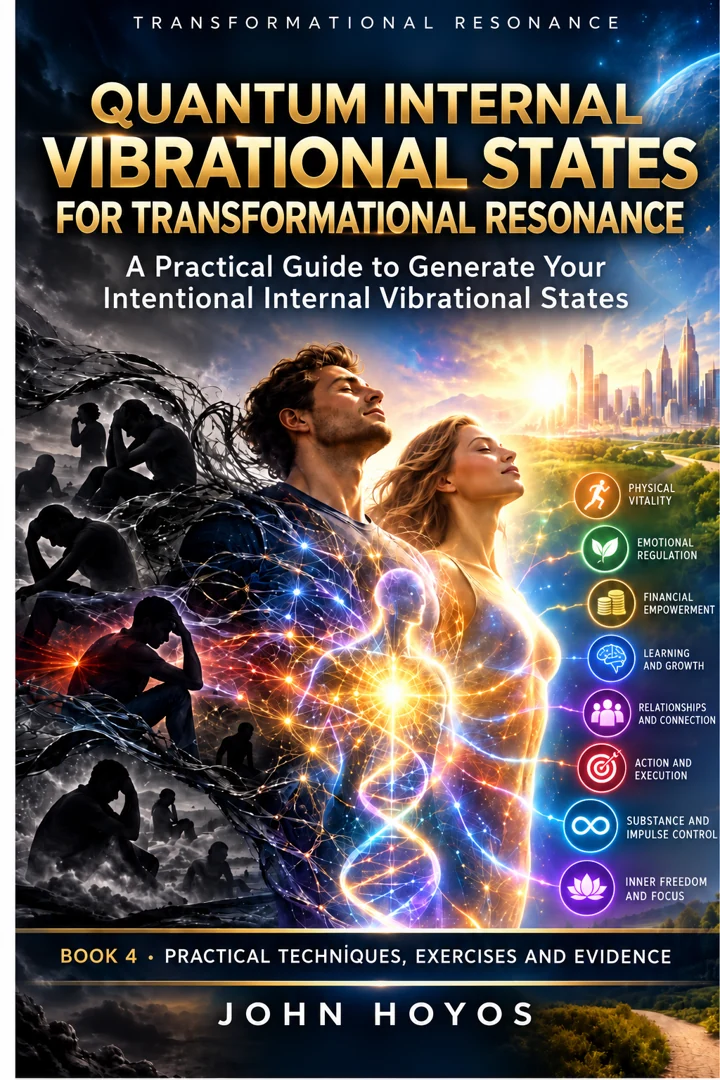 BOOK 4
The Quantum Vibrational Foundation of Individual Reality
Read Chapter 1 preview →Look at a tree. You see a trunk, branches, leaves, color, depth, texture, perhaps movement in the wind. It feels as though the tree itself is simply entering consciousness exactly as it exists. But no tree enters your brain. Light interacts with the tree. Some wavelengths are absorbed, some scattered or reflected. A portion of that electromagnetic radiation reaches your eyes. Photoreceptors in the retina respond.
Neural signals travel through increasingly complex pathways. The brain combines those signals with information about edges, contrast, motion, depth, memory, context, and expectation. Then you experience: tree. The experience is real. But it is a construction. Sensory Transduction From One Quantum Event to Experience The conversion from physical reality to experience is not merely an abstract metaphor. It can begin with events at the smallest scales.
In vision, a photon can be absorbed by a light-sensitive molecule in a photoreceptor. That molecular change initiates a biochemical cascade, alters ion-channel activity, changes the electrical state of the cell, and can ultimately contribute to a neural signal. The important lesson is not that every quantum event becomes conscious. Most microscopic events disappear into thermal noise or are averaged with enormous numbers of other events.
The lesson is that a microscopic difference can become macroscopic when a biological system contains a pathway capable of preserving and amplifying it. This is the first bridge between the sublayer and the surface: microscopic interaction → molecular change → cellular amplification → neural information → experience. Every sensory system faces the same basic problem: physical reality must somehow become biological information.
This conversion is called sensory transduction. Light changes the state of photoreceptors. Pressure waves move structures in the ear and ultimately influence hair cells. Airborne molecules interact with olfactory receptors. Mechanical deformation activates receptors in the skin. Temperature changes influence thermoreceptors. The body does not consciously experience photons, receptor chemistry, ion currents, or synaptic transmission.
It experiences the conclusion produced by all of them. The basic chain is: PHYSICAL INTERACTION -> BIOLOGICAL RECEPTOR CHANGE -> NEURAL INFORMATION -> BRAIN PROCESSING -> CONSCIOUS EXPERIENCE By the time you see the tree, an enormous transformation has already occurred. Your Senses Select Human sensory systems do not detect everything that physically exists around us. Electromagnetic radiation extends far beyond visible light.
Radio waves can pass through the room. Infrared radiation surrounds you. Ultraviolet radiation reaches Earth. Wi-Fi signals carry information through your home. You do not see them directly. Microorganisms can be present on a surface that looks perfectly clean. Molecules can enter your nose at concentrations too low for conscious detection. Your body is constantly experiencing physical events that never become conscious experience.
The nervous system therefore does not give us all of reality. It gives us a biologically useful selection. Evolution did not need to provide an organism with a philosophical representation of the universe. It needed systems capable of guiding survival and action. That distinction is profound. Your sensory world is not a complete photograph of reality. It is an interface. Color Is a Relationship Consider a red apple.
We casually say: The apple is red. At the level of everyday communication, this is correct. But descend beneath experience. The apple's material structure interacts with incoming light. Different wavelengths are absorbed and reflected differently. The light reaching the eye stimulates photoreceptors in particular patterns. Neural systems compare those patterns. The brain produces a color experience.
There is no small object called redness inside the apple. Color emerges through a relationship among: light, the object, the sensory system, and the brain.
A short opening excerpt from Chapter 1 of Book 1 by John Hoyos. The complete chapter continues in the book. The series uses a conceptual personal-development framework; these readings are educational.
The Hidden Beginning A glass falls from a table, a person hears the crash, turns, recognizes danger, and acts. Consciousness sees one event. The sublayer contains a long history: gravity changed motion, molecules collided, pressure waves crossed air, receptors changed state, neurons fired, memories were recruited, and muscles reorganized matter again. This is the first discipline of the deepest-layer view: refuse to stop at the name of the outcome.
A label such as sound, fear, choice, impact, attraction, or success describes an upper layer. To understand how it became possible, we have to ask which variables changed underneath it, which systems were coupled, and which physical differences survived long enough to matter. The Mechanism The central mechanisms in this chapter are these: microscopic causes precede visible outcomes; the experienced event is a late-stage summary; causal histories cross many levels of organization.
Each phrase points to a different role in the chain. A system begins in a state. Some difference distinguishes that state from its surroundings or from an earlier moment. If a coupling path exists, that difference can alter another system. Whether the alteration persists depends on receiver structure, environmental conditions, competing processes, and the availability of amplification. Across the Layers A compact example is: falling glass -> collision -> pressure wave -> cochlear transduction -> neural interpretation -> movement.
Read the arrows carefully. They do not mean that every step is inevitable. Each arrow hides conditions. Energy must be available. Geometry must permit contact. A receptor may or may not be sensitive. Noise may mask a signal. A threshold may not be crossed. Another pathway may dominate. The visible event therefore represents the history of all the filters that were successfully traversed. The same logic helps us connect scales.
At a microscopic level, interactions may involve photons, electrons, atoms, molecular collisions, quantum states, or chemical bonds.
A short opening excerpt from Chapter 1 of Book 2 by John Hoyos. The complete chapter continues in the book. The series uses a conceptual personal-development framework; these readings are educational.
A Simple Physical Analogy Place a ball at the top of a ramp and release it. Gravity acts, the ball accelerates, and a visible trajectory appears. Now place the same ball halfway down the ramp and release it again. The laws have not changed, but the trajectory has. Change the angle, surface friction, initial speed, or surrounding medium and the same underlying laws operate on a different state. Physics often describes a system through variables that characterize its condition at a given moment.
A simple mechanical state might include position and velocity; a gas may be described by pressure, volume, and temperature. A human state is vastly more complicated, but the same conceptual lesson remains useful: outcomes depend not only on laws, but also on the conditions entering those laws. A Human State Is Multidimensional At this moment, your brain contains patterns of electrical and chemical activity. Your blood carries particular concentrations of glucose, hormones, electrolytes, oxygen, and carbon dioxide.
Your muscles have a certain tension. Your heart and lungs are operating at particular rates. Your sensory systems are receiving information while attention selects only a fraction of it. Memory contributes prior information, expectations shape anticipation, emotion changes salience, and learned skills constrain which actions are available. There is therefore no single number that captures a human internal state. It is not one vibration or one frequency.
It is a high-dimensional organization whose components operate at different timescales: milliseconds for neural firing, minutes or hours for hormonal regulation, weeks for muscular adaptation, years for expertise, and sometimes decades for identity and relational patterns. The Same Situation Is Not the Same Situation Imagine entering a room where ten strangers are waiting. In one condition you have slept three hours, you are worried about money, your heart rate is elevated, and you expect rejection.
A short opening excerpt from Chapter 1 of Book 3 by John Hoyos. The complete chapter continues in the book. The series uses a conceptual personal-development framework; these readings are educational.
The Surface and the Sublayer Look at your hand. It appears solid, bounded, and located in a definite region of space. Move it and consciousness presents a familiar event: a hand travels toward an object, contact occurs, and the object changes position. That description is useful at the macroscopic level, but it is not the deepest description of the event. At the sublayer, the familiar visual hand is not a fundamental indivisible entity.
The physical description involves quantum- governed matter, fields, molecular structure, electromagnetic interaction, energy, momentum, gradients, probabilities, and changing configurations. The hand is real as an emergent physical organization and as a perceptual object, but it does not exist at the fundamental layer in the same form in which consciousness experiences it. This distinction is central to the book: the surface gives us objects; the sublayer gives us interaction.
The Standard Quantum Vibrational State In molecular quantum mechanics, bonded atoms possess vibrational degrees of freedom. In the harmonic approximation, allowed vibrational energies are quantized: E_v = (v + 1/2) hbar omega, with v = 0,1,2,... . Even the lowest state contains zero-point energy. A quantum vibrational state is therefore an allowed quantum state associated with vibrational motion and quantized vibrational energy.
A quantum vibrational state is not simply a frequency. Frequency participates in the description, but state, energy, mode, and transition are different concepts.
A short opening excerpt from Chapter 1 of Book 4 by John Hoyos. The complete chapter continues in the book. The series uses a conceptual personal-development framework; these readings are educational.
The promotional videos are being prepared. These slots will become available when each video is ready.
Coming soon
Coming soon
Coming soon
Coming soon
Coming soon
Coming soon
Coming soon
Coming soon
Coming soon
Coming soon